

Multipolar Stability: The New Geopolitical Paradigm
Why Multipolarity is the Path to Resilience, Not Chaos

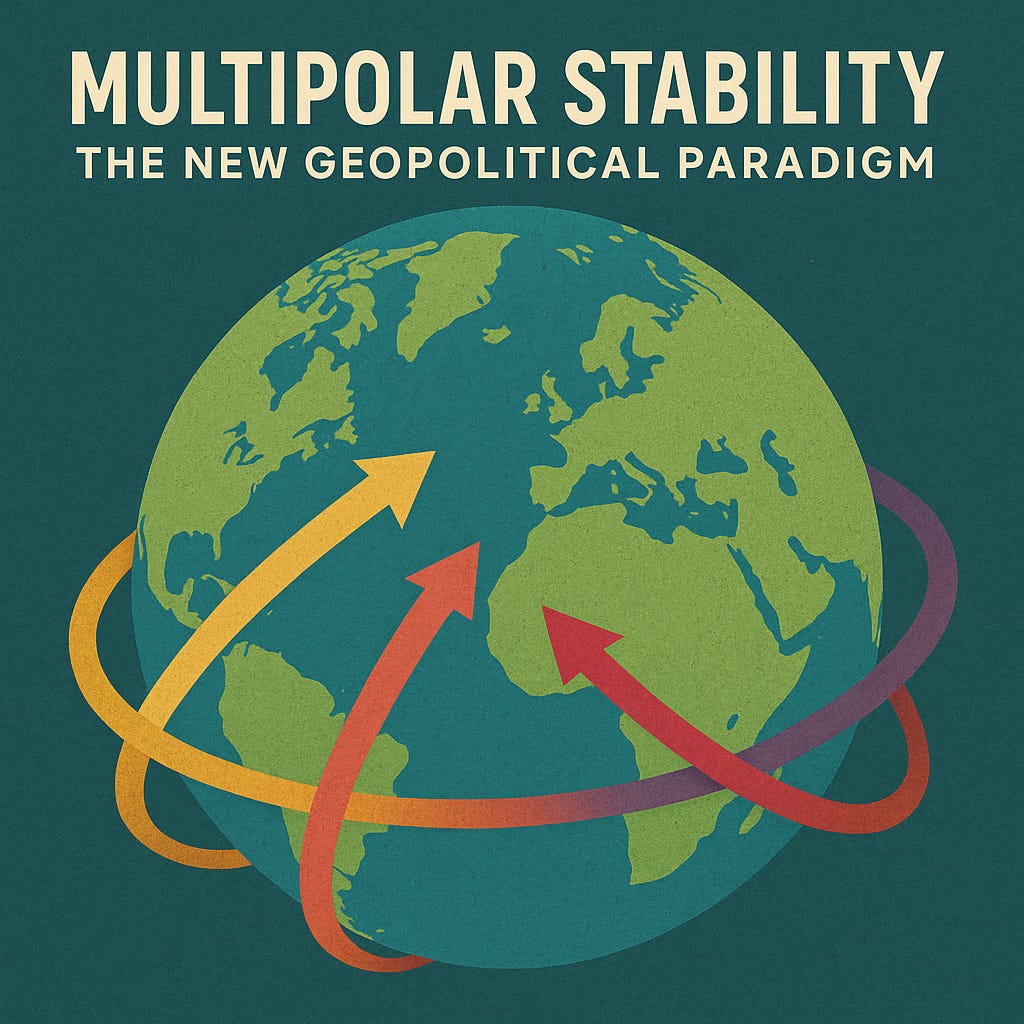
Multipolar Stability: The New Geopolitical Paradigm
Why Multipolarity is the Path to Resilience, Not Chaos
The dominant geopolitical narrative holds that a unipolar or bipolar world is inherently more stable. This belief, rooted in the linear thinking of hierarchical power dynamics, posits that fewer decision-makers reduce complexity, making the global stage more predictable and, therefore, safer. Following the Cold War, the United States' dominance established a unipolar moment where global stability seemed tied to the singular influence of American power. Yet, the world has since evolved into a multipolar structure, with emerging powers such as China, India, the European Union, and blocs like BRICS reshaping the global landscape.
Conventional wisdom suggests this shift introduces instability—more power centers mean more chances for conflict and unpredictability. However, this perspective fails to account for the adaptive, resilient nature of complex systems. In contrast, I propose that a multipolar world not only challenges old power structures but introduces a new form of systemic stability. Much like biodiversity strengthens ecosystems, multipolarity enhances geopolitical resilience. Rather than being more dangerous, it is, in fact, more robust, dynamic, and capable of metabolizing conflict through distributed influence and adaptive negotiation.
The Assumption of Danger
Traditional geopolitical frameworks operate under the assumption that more nodes of power inherently increase volatility. The analogy often used is a chessboard with more pieces—more moves, more conflict, more chaos. This thinking is linear and assumes that the primary mode of interaction is confrontation rather than adaptation. In a unipolar world, dominance is maintained through suppression or coercion. In a bipolar world, conflict is managed through containment and deterrence. Multipolarity, however, introduces a non-linear model where power is distributed, alliances are fluid, and influence is negotiated across a broader spectrum of interests.
Yet, this multiplicity is not inherently dangerous. In ecology, monocultures are fragile—susceptible to collapse when disrupted. Complex ecosystems with diverse interdependencies are resilient because they distribute risk and metabolize shocks more effectively. In the same way, a multipolar world diffuses power, creating multiple avenues for resolution and adaptation. Rather than centralizing risk, it distributes it across many actors, enhancing collective stability.
A New Biosphere: Multipolar Stability
Distributed Risk: Power is decentralized, preventing any single point of failure from destabilizing the global order. A conflict between two nations, while significant, does not reverberate uncontrollably across the entire system. Regional power structures absorb and mitigate shocks, maintaining broader stability.
Dynamic Equilibrium: With multiple power centers, geopolitical stability is maintained not through dominance but through constant recalibration. The system self-regulates through negotiation, economic interdependence, and diplomatic leverage. Each actor, in seeking its own stability, inadvertently contributes to the stability of the whole.
Adaptive Mechanisms: A multipolar world requires diplomatic agility. More players mean more nuanced negotiations, less binary confrontation, and increased incentives for multilateral cooperation. Adaptation becomes a structural necessity, not just a strategic choice.
Cognitive Complexity: Nations must metabolize new challenges faster, leading to accelerated learning and adaptation. The constant flux of alliances and power dynamics forces states to innovate politically and economically to remain relevant.
Acceleration and Creative Destruction: One of the critical features of a multipolar world is the velocity of change. Decisions are made rapidly, crises emerge and dissipate with speed, and the geopolitical landscape evolves at a pace previously unimaginable. While this rapidity introduces the risk of short-term instability, it is the inertia of outdated regulatory and intellectual frameworks that poses a more significant threat. Capitalism, to thrive, requires creative destruction—an economic mechanism where outdated institutions and technologies are dismantled to make way for innovation. In a multipolar order, this happens faster, enabling economies to adapt, adjust, and flourish rather than stagnate. Speed, therefore, should not be conflated with danger; it is the engine of adaptive stability.
Real-World Case Studies of Multipolar Acceleration
The Rise of Re-industrialization and Localism: In the face of global supply chain disruptions and geopolitical instability, nations are shifting towards re-industrialization and localism. The COVID-19 pandemic exposed the fragility of global networks, prompting countries to bring manufacturing back home and localize production. This acceleration in localism is not merely a defensive mechanism; it is a reimagining of economic sovereignty. Distributed production, regional self-sufficiency, and resilient local economies are becoming the backbone of a multipolar order.
America's Economic and Demographic Shift South: The United States is witnessing a profound economic and demographic shift towards the South. Cities like Austin, Nashville, and Atlanta are emerging as new economic powerhouses, pulling influence away from the traditional Northeast and West Coast strongholds. This shift is emblematic of adaptive stability, where economic power is dispersing geographically, leading to a more distributed and resilient economic landscape.
The Rise of India as the World's Third Largest Economy: India's meteoric rise to become the third-largest economy globally signifies a seismic shift in economic power. With its robust tech sector, manufacturing expansion, and strategic geopolitical positioning, India is emerging as a stabilizing force in South Asia and a counterbalance to Chinese influence. Its youthful population and growing middle class are driving internal consumption and outward investment, making it a cornerstone of multipolar economic strength.
The Success of Melei's Government in Argentina: Melei's economic reforms in Argentina are redefining political and economic strategy in South America. His focus on deregulation, currency stabilization, and infrastructure investment has catalyzed growth and restored faith in national governance. It serves as a clear example of adaptive resilience in a multipolar world where regional leaders drive systemic change without reliance on Western economic models.
Decentralized Energy Markets: Energy independence and decentralized production models are reshaping global energy politics. Localized energy grids and community-based renewable projects are not just environmental strategies; they are geopolitical stabilizers that reduce dependence on global supply chains and volatile markets.
Framing Multipolarity as Strength
Reframing multipolarity as a strength rather than a liability unlocks strategic advantages. It moves the narrative away from risk aversion and towards adaptive growth. In this framework, conflict is not avoided but metabolized—transformed into an opportunity for reconfiguration and stabilization. This paradigm shift would redefine international relations, encouraging distributed governance, resilient political ecosystems, and multi-layered cooperation.
Conclusion
Multipolarity is not a step backward into chaos; it is an evolutionary leap into systemic stability. By distributing influence and diversifying risk, it mimics the resilience of natural ecosystems—adaptive, fluid, and robust. Understanding and embracing this shift enables a more resilient geopolitical strategy, one that does not resist complexity but thrives within it. Moreover, the acceleration of decision-making and economic turnover is not a threat—it is the recalibration mechanism for adaptive strength. Embracing this speed is embracing the creative destruction necessary for global advancement.